I connected creative testing, paid media and conversion design into one full-funnel fashion system. Every launch was measured against qualified demand, product interest and revenue efficiency. I worked across audience insight, offer structure, landing-page clarity and weekly optimization so the account could scale without losing control of the customer experience.
Women’s Fashion Brand: 10.46x ROAS
I connected creative testing, paid media and conversion design into one full-funnel fashion system. Every launch was measured against qualified demand, product interest and revenue efficiency. I worked across audience insight, offer structure, landing-page clarity and weekly optimization so the account could scale without losing control of the customer experience.
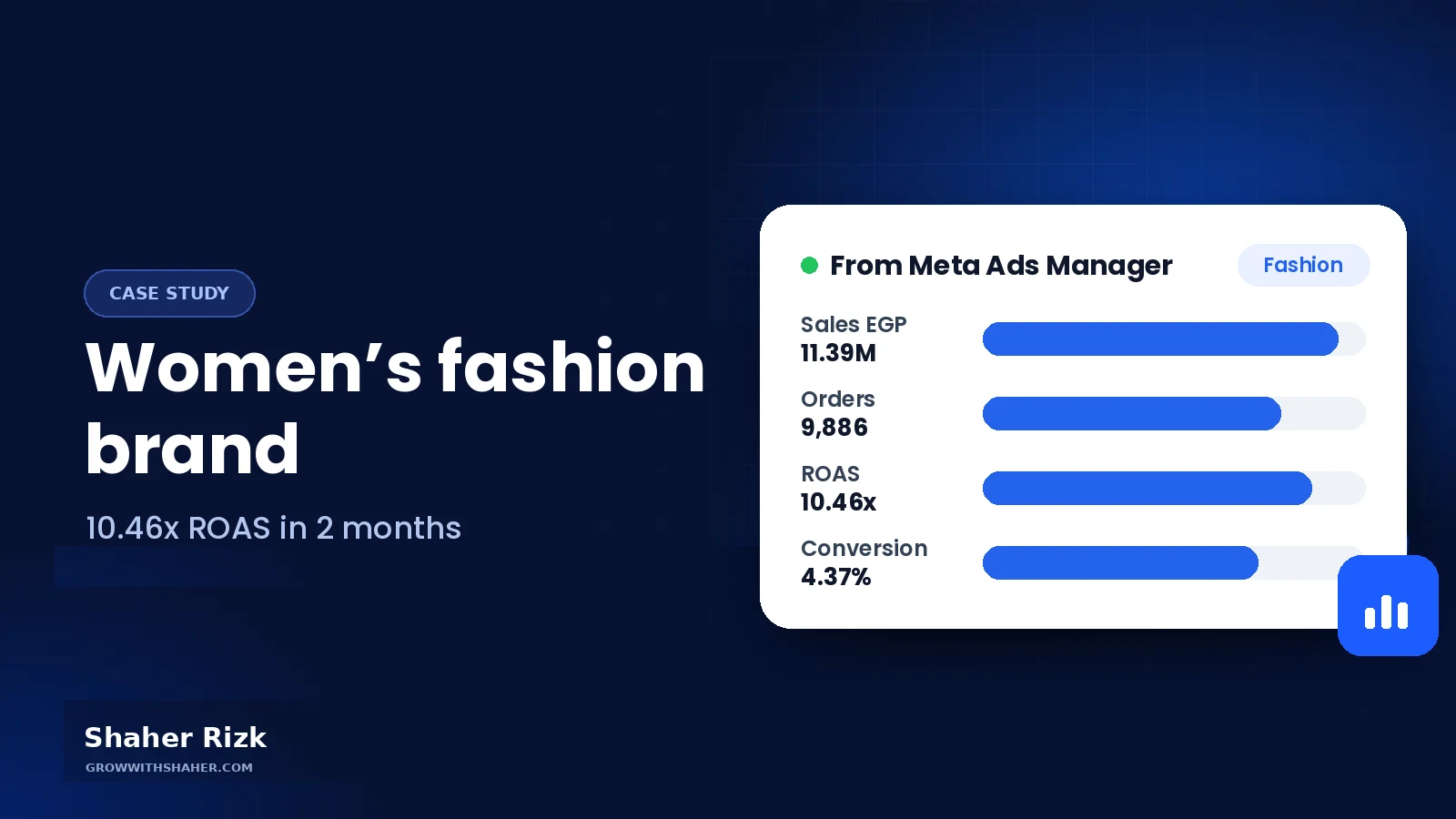
It started with a call from the owner: “I have a lot of stock, my money is stuck in the warehouse and I’m drowning.” Two months later, the second call was: “Stop scaling, I can’t keep up with the orders!” In between: EGP 11.39M in sales, 9,886 orders and a 10.46x ROAS, from EGP 1.09M in ad spend.
Where the money went and what came back
Source: Meta Ads Manager, 373 ad sets over the two months. Average order is sales ÷ orders.
I looked at the whole business, not only the dashboard
A good ROAS means nothing if the brand is not making money. So the work started long before the first campaign.
Understand it before running ads
The first step was not opening Ads Manager. I sat with the owner and went through the real product cost, pricing, margins and the customer experience on the site, so ad results and profit were never judged separately. I also asked for two pieces to be sent to two different women to wear and wash for a week. That test paid off later.
Cheapest is not always an advantage
The old prices could lose money even with sales coming in, and the brand was selling below a competitor priced at EGP 1,000. I repriced the range between that competitor and one at EGP 1,300, as long as the quality justified it. A low price does not always sell more, and high sales do not always mean profit.
The buying experience is part of the sale
I unified the colors and visual identity, improved the UX, simplified the purchase funnel, fixed technical issues that could block an order, and added real customer reviews on product pages. The ad brings the customer in; the site has to help her decide.
Every ad has a job
Instead of many videos saying the same thing, I worked with different UGC creators and wrote scripts for each audience stage: cold, warm, hot and retention. Each marketing angle answered a specific need or objection.
Built on value, not discounts
No “buy one, get the second at half price”. Not because it doesn’t work, but because I wanted a reason to buy that does not depend on cutting the price: better service, an easier purchase, a clear guarantee and product quality she can trust.
One ad set, every creative
I started with an ABO campaign with one ad set holding all the creatives. It was not a fair contest between ads; it was a way to run a set of messages for different stages and let Meta find who to show them to.
Each creative judged on its own
I copied the main ad set into a new ABO campaign with one creative per ad set, and kept the first campaign running as an evergreen campaign. After about 5 days I paused the weak ad sets based on spend and results, not just because an ad spent without an order.
From one winner to many chances
I duplicated winning ad sets inside the same ABO campaign and tested copies in a new CBO campaign. I used Shopify data to test the strongest regions on their own, tried different age groups, and split promising interests from stacked-interest tests into their own ad sets. The data decided which chance deserved more budget.
Conversion rate went from 1.67% to 4.37%
| Metric | Before | After |
|---|---|---|
| Conversion rate | 1.67% | 4.37% |
| Change | — | +162% |
1.67% was fine for the owner, but I saw room for more. What scares a woman buying clothes online? Will the fabric look like the photos, will it pill, will it shrink, and can she get her money back? The fabric test from day one meant I could answer that honestly. So I added one message on the cart page: “Full refund within 90 days for any manufacturing defect, pilling or shrinkage.”
The jump was recorded after the message went live. To credit it to the message alone, I would need a test isolated from the other changes. Sometimes you don’t need a new creative or a bigger budget; you need to understand what the customer is thinking before she pays.
The services I used in this case
Questions people ask about this case
How much did this women’s fashion brand sell?
EGP 11,394,441 in sales from 9,886 orders in two months, from EGP 1,089,530 in ad spend, as shown in Meta Ads Manager.
Who ran this account?
I ran the account myself.
Was it only the ads?
No. Pricing, product quality, the website, creative and media buying were worked on together. That is why the result held up when the budget went up.
Why don’t you show the brand name?
Most of my clients prefer to keep their name private, so I share the numbers and what I did, without the brand.

Who ran it
I ran this account myself, and the numbers above come straight from the ad account. If you want me looking at your store, the first step is a free growth call.